Primary and Secondary
Structures - Meteorites |
3. Recrystallized Kamacite |
| Listing of Structures |
| Back...Next |
| Meteorite - Seneca Falls, IAB Iron. |
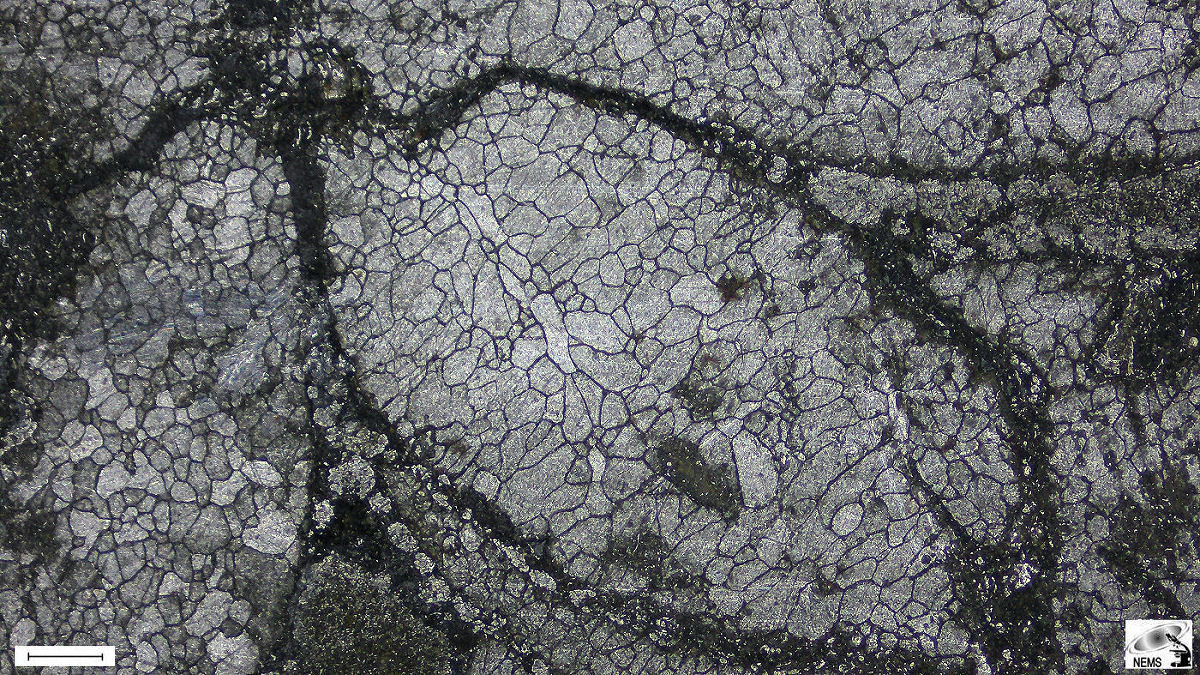
| Figure 1. Scale bar 200
µm. Meteorite - Seneca Falls Classification - Iron, IAB-Mg, 8.2% Ni, 0.3 P Recrystallized kamacite - Secondary. |
| Recrystallized
Kamacite Recrystallized kamacite represents a key secondary microstructural feature in many iron meteorites, providing direct evidence of post-formation shock metamorphism followed by thermal annealing. Kamacite (α-FeNi), the low-nickel (typically 5–7.5 wt% Ni) body-centered cubic (bcc) alloy that dominates the Widmanstätten pattern in most iron meteorites, is highly susceptible to deformation and subsequent recovery processes. When subjected to intense shock waves and residual heating, its deformed crystals can recrystallize into strain-free, equiaxed grains, erasing or modifying primary textures. This process offers critical insights into the dynamic collisional history of asteroidal parent bodies in the early solar system. Primary Formation and Secondary Modification of Kamacite In undisturbed iron meteorites, kamacite forms as oriented lamellae during slow cooling (typically 1–100 °C per million years) of the parent-body Fe-Ni core through the taenite to a kamacite phase transformation, producing the characteristic Widmanstätten intergrowth. Primary kamacite is often coarse and exhibits deformation features such as Neumann lines (mechanical twins) from mild shock. Recrystallization occurs as a secondary process when shock pressures and post-shock temperatures are sufficient to drive recovery, polygonization, and grain boundary migration. Shock events deform the crystal lattice, introducing dislocations and twinning. Subsequent reheating—commonly from residual impact heat—allows nucleation of new, strain-free grains. This annealing typically requires temperatures above ~400–500 °C for significant recrystallization in kamacite, with grain size depending on peak temperature, duration, and degree of prior deformation. In heavily affected meteorites, the original Widmanstätten pattern may be partially or completely overprinted. Common associated features include: Equiaxed kamacite grains (often 10–300 µm) Recrystallized or spheroidized taenite lamellae Shock-melted troilite nodules Fragmented or mobilized sulfides and phosphides These textures distinguish natural cosmic reheating from potential terrestrial alteration. Case Study: Seneca Falls Meteorite Classification: Iron, IAB-Mg (medium octahedrite), ~8.2 wt% Ni, ~0.3 wt% P. The Seneca Falls meteorite, found in 1850, exemplifies shock-induced recrystallization. Originally displaying a primary Widmanstätten structure typical of IAB-complex irons, it experienced intense impact events that caused widespread deformation and fracturing. Residual heat from these shocks triggered thermal metamorphism, recrystallizing both kamacite and taenite. In thin section, kamacite has recrystallized into equiaxed polyhedral grains ranging from approximately 50 to 250 µm in diameter (Figures 1–4). These grains lack the preferred orientation of primary lamellae and show smooth, curved boundaries indicative of grain growth during annealing. Taenite lamellae are also recrystallized and fragmented, appearing as segmented remnants (notably at the bottom of Figure 1). Historical Interpretation Early analysis by Berwerth (1914) attributed the unusual polyhedral kamacite to artificial reheating (e.g., by human activity post-recovery). However, detailed petrographic study by Buchwald (1975) demonstrated a natural cosmic origin. Key evidence includes shock-melted troilite and taenite lamellae fragmented into segments 50–400 µm across, consistent with hypervelocity impact processes rather than laboratory or forge heating. The association of recrystallized metal with melted sulfides strongly supports in-space shock reheating. Broader Implications Recrystallized kamacite is observed across multiple iron groups (e.g., IIIAB, IVA, IAB) and serves as a marker in progressive shock-stage classifications for metallic meteorites. It records impact energies capable of locally melting troilite (~1000–1100 °C) while annealing the surrounding metal. Such events likely occurred during parent-body disruption or later collisions in the asteroid belt. Microstructural and microchemical studies (optical microscopy, SEM, EPMA, EBSD) of these features help constrain peak temperatures, cooling rates post-reheating, and the overall collisional evolution of planetesimals. In Seneca Falls and similar specimens, these secondary structures underscore that iron meteorites preserve complex, multi-stage histories involving both slow igneous differentiation and violent impact processing. |
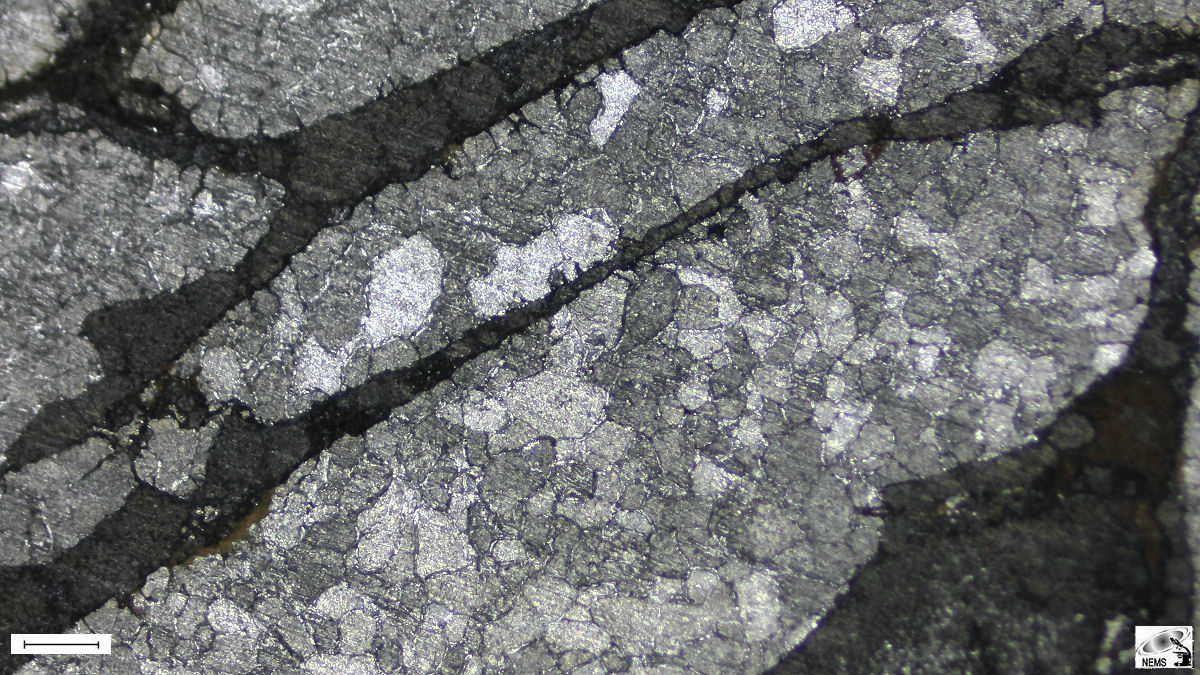 |
| Figure 2. Scale bar 100
µm. |
| Recrystallized kamacite
lamellae, Seneca Falls. |
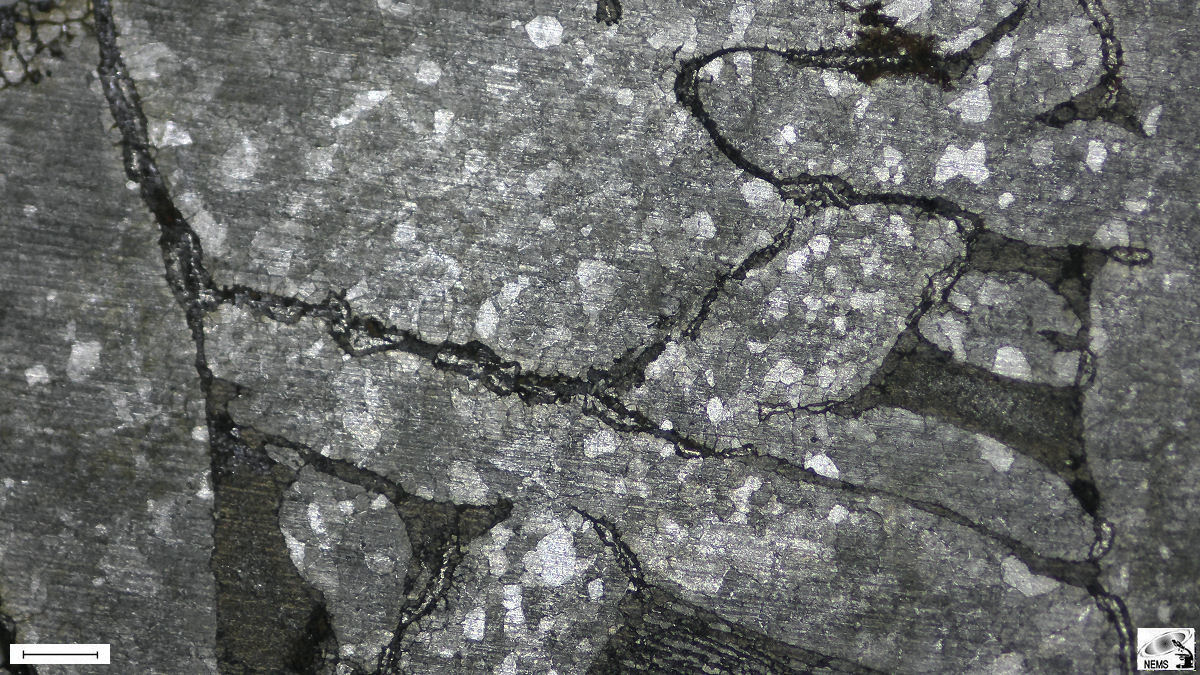 |
| Figure 3. Scale bar 300
µm. |
| Recrystallized kamacite
lamellae, Seneca Falls. |
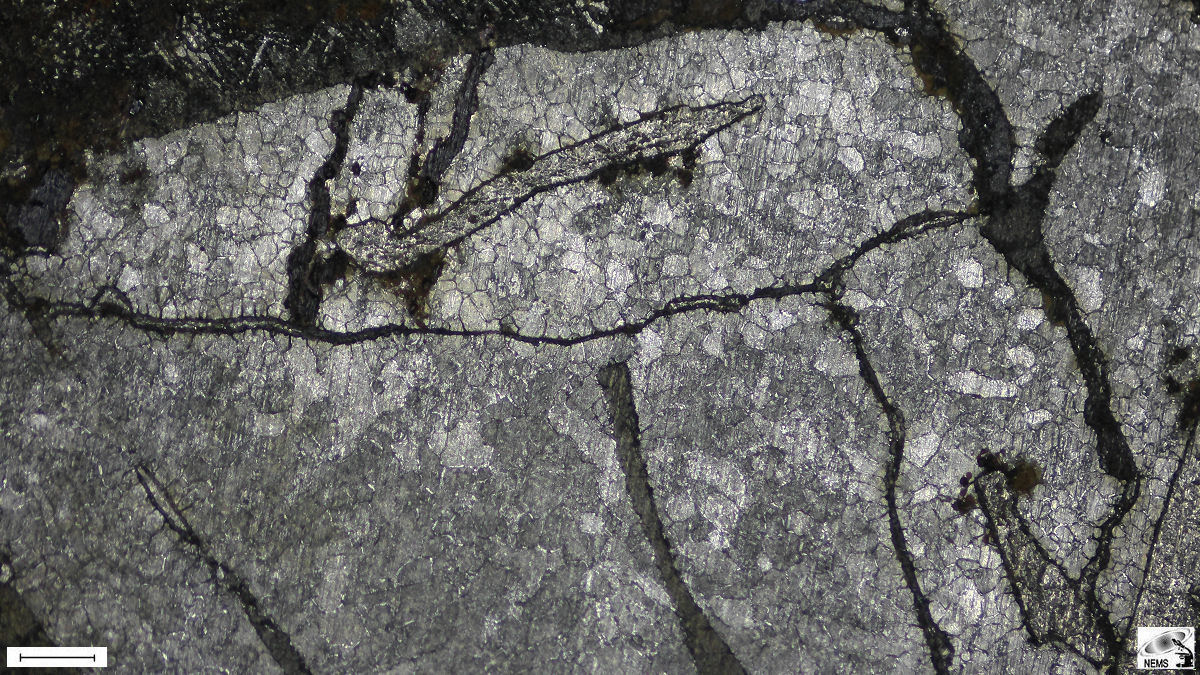 |
| Figure 4. Scale bar 300
µm. |
| Recrystallized kamacite lamellae, Seneca Falls. |
| References Buchwald, V.F. (1975). Handbook of Iron Meteorites. University of California Press. (Essential — extensively describes recrystallized kamacite as a secondary feature from shock heating/annealing. Buchwald, V.F. (1977). “The Mineralogy of Iron Meteorites.” Philosophical Transactions of the Royal Society A. Discusses kamacite recrystallization alongside plessite annealing and shock effects. Shock, Deformation & Recrystallization Studies Yang, J. et al. (various works, e.g., on cooling rates and thermal histories). Scott, E.R.D. & others (Oxford Research Encyclopedia entry on Iron Meteorites, 2020). Notes significant reheating of shocked kamacite leads to recrystallization; good for broader parent-body context. |
| Listing of Structures |
| ... |